

Over three days at UNESCO Headquarters in Paris, Indonesia showcased the good practices from the GEF-6 CFI Indonesia, introduced its Artificial Intelligence (AI)-powered Electronic Logbook, and was entrusted with moderating the development of global recommendations to strengthen data, information, and knowledge management across the Large Marine Ecosystems (LME) network.
Indonesia reaffirmed its leadership in advancing global ocean governance through its active participation in the 25th Annual Consultative Meeting on Large Marine Ecosystems (LME25) and the 2nd Data and Information Management (DIM) Workshop, held at UNESCO Headquarters in Paris, France, from 7–9 July 2026.
Represented by the Directorate General of Capture Fisheries of the Ministry of Marine Affairs and Fisheries (MMAF) together with Global Environment Facility–6 Coastal Fisheries Initiative (GEF-6 CFI) Indonesia, the country contributed to discussions on strengthening Large Marine Ecosystem (LME) management, transforming marine data systems, and harnessing digital technologies to support evidence-based decision-making.
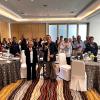
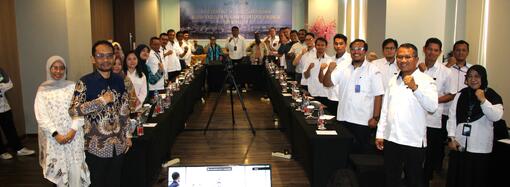
ok.jpeg) Group photo of participants attending the 25th Annual Consultative Meeting on Large Marine Ecosystems (LME25) at UNESCO Headquarters, Paris, France, symbolizing a shared commitment to strengthening international collaboration on the management of Large Marine Ecosystems (LMEs) and GEF International Waters.
Group photo of participants attending the 25th Annual Consultative Meeting on Large Marine Ecosystems (LME25) at UNESCO Headquarters, Paris, France, symbolizing a shared commitment to strengthening international collaboration on the management of Large Marine Ecosystems (LMEs) and GEF International Waters.
Organized by IW:LEARN, the Global Environment Facility (GEF), UNESCO-IOC, FAO, UNDP, and UNEP, the forum brought together governments, international organizations, research institutions, Regional Fisheries Management Organizations (RFMOs), Regional Seas Programmes (RSPs), academia, and marine project managers from around the world. The meeting provided a strategic platform to exchange good practices, strengthen international collaboration, and formulate joint recommendations to advance the achievement of Sustainable Development Goal (SDG) 14 – Life Below Water.
One of the sessions that attracted significant attention was Indonesia's presentation on its Artificial Intelligence (AI)-powered Electronic Logbook Version 3. Developed through GEF-6 CFI Indonesia, the innovation is designed to accelerate data validation, improve the accuracy of fish species identification, and support more efficient fish stock assessment.
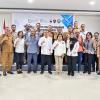
.jpeg) Dodiet Rachmadi Slamet, representing the Directorate of Fisheries Resources Management, Ministry of Marine Affairs and Fisheries, presented Indonesia's Artificial Intelligence (AI)-powered Electronic Logbook as one of the country's good practices during the 25th Annual Consultative Meeting on Large Marine Ecosystems (LME25) in Paris, France. The innovation supports the implementation of Quota-Based Fisheries (PIT) by strengthening a more accurate, efficient, and science-based fisheries data system.
Dodiet Rachmadi Slamet, representing the Directorate of Fisheries Resources Management, Ministry of Marine Affairs and Fisheries, presented Indonesia's Artificial Intelligence (AI)-powered Electronic Logbook as one of the country's good practices during the 25th Annual Consultative Meeting on Large Marine Ecosystems (LME25) in Paris, France. The innovation supports the implementation of Quota-Based Fisheries (PIT) by strengthening a more accurate, efficient, and science-based fisheries data system.
Representing the MMAF and serving as Technical Coordinator of the GEF-6 CFI Indonesia PMU, Dodiet Rachmadi Slamet explained that AI has been developed as a tool to streamline data analysis, rather than replace human expertise.
"Artificial Intelligence is not intended to replace people, but to help us process millions of fisheries data records far more rapidly. With AI support, data verification and analysis can be carried out more efficiently, enabling fisheries management policies to be developed based on more accurate information," said Dodiet.
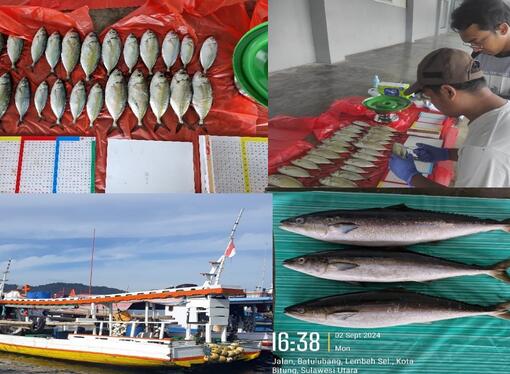
He noted that Indonesia has more than 500,000 small-scale fishing vessels, generating an enormous volume of fisheries data. By applying machine learning, the AI system has been trained with thousands of images representing different fish species, significantly improving species identification accuracy and accelerating the development of scientific recommendations.
The presentation received broad recognition from participants. Delegates from various countries and international organizations viewed the AI-powered Electronic Logbook as a good practice with strong potential for replication to strengthen fisheries data systems, improve fish stock assessments, and support evidence-based decision-making.
.jpeg) Discussion session on “AI Tools in Support of Data and Information Management (DIM)”, highlighting the application of AI and digital transformation to strengthen Data and Information Management (DIM) across the GEF International Waters portfolio.
Discussion session on “AI Tools in Support of Data and Information Management (DIM)”, highlighting the application of AI and digital transformation to strengthen Data and Information Management (DIM) across the GEF International Waters portfolio.
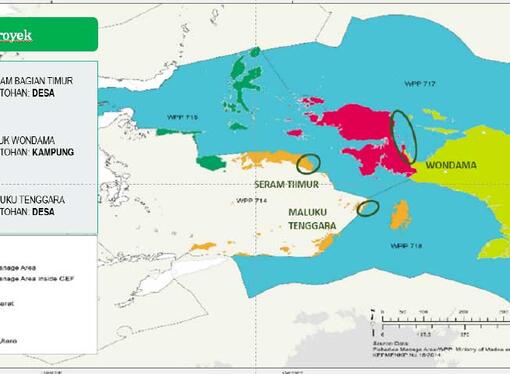
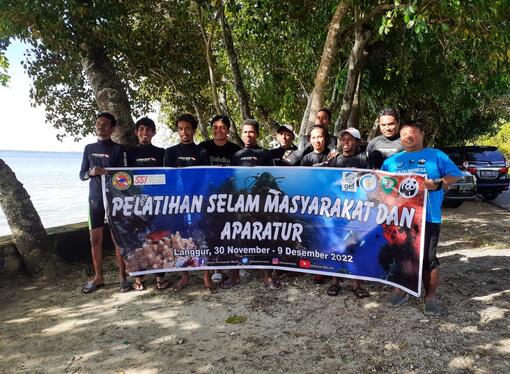
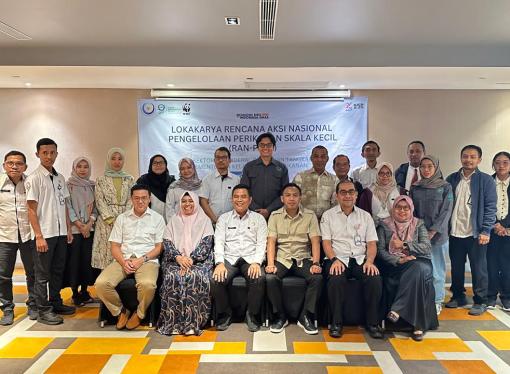
Beyond digital innovation, participants also highlighted the achievements of GEF-6 CFI Indonesia in strengthening ecosystem-based fisheries management. Initiatives to strengthen fisheries governance, develop the SASI Label, empower coastal community, and develop women's capacity, as well as multi-stakeholder collaboration among government agencies, academia, communities, and the private sector demonstrated how GEF investments can generate sustainable institutional change.
Indonesia also shared its experience in ensuring programme sustainability through institutional strengthening of local government, the development of Payment for Ecosystem Services (PES) mechanisms, partnerships with the private sector, expanded market access for women-led coastal micro, small and medium enterprises (MSMEs), and the development of Local Champions.
During the DIM Workshop, Indonesia presented several strategic recommendations to strengthen global marine data management, including the development of an integrated LME data platform, harmonization of international reporting systems, expanded use of Artificial Intelligence, and the establishment of an LME Portfolio Dashboard as a shared information platform for all LME projects.
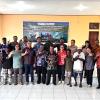
.jpeg) Breakout session during the 2nd Data and Information Management (DIM) Workshop discussing the strengthening of Data and Information Management (DIM) across the GEF International Waters (IW) portfolio, including data and reporting priorities, dashboard development, performance indicators, system sustainability, and the application of Artificial Intelligence (AI) to support data management and reporting. Adipati Rahmat, Project Manager of the GEF-6 CFI Indonesia PMU, served as moderator for one of the breakout sessions.
Breakout session during the 2nd Data and Information Management (DIM) Workshop discussing the strengthening of Data and Information Management (DIM) across the GEF International Waters (IW) portfolio, including data and reporting priorities, dashboard development, performance indicators, system sustainability, and the application of Artificial Intelligence (AI) to support data management and reporting. Adipati Rahmat, Project Manager of the GEF-6 CFI Indonesia PMU, served as moderator for one of the breakout sessions.
Indonesia's growing international recognition was further reflected when Adipati Rahmat, Project Manager of the GEF-6 CFI Indonesia PMU, was invited to moderate the closing session entitled "Recommendations to Improve Data, Information and Knowledge Management (DIM) at the Portfolio Level." The session brought together representatives from LME projects, international organizations, and development partners to formulate recommendations for strengthening data, information, and knowledge management across the global portfolio.
Under Indonesia's moderation, participants agreed on several key recommendations, including strengthening national ownership of data systems, establishing long-term financing mechanisms, improving data quality, expanding the application of AI, developing the LME Portfolio Dashboard, and enhancing international collaboration to ensure the long-term sustainability of global marine information systems.
According to Adipati Rahmat, Indonesia's experience demonstrates that transforming ocean governance depends not only on technological innovation but also on high-quality data, strong institutions, and effective multi-stakeholder collaboration.
"The experience of GEF-6 CFI Indonesia demonstrates that data are the foundation of sustainable marine resource management. When governments, research institutions, communities, and development partners work together to build robust data systems, the resulting policies will be more accurate, transparent, and better equipped to address future fisheries management challenges," said Adipati.
He added that the confidence placed in Indonesia to moderate the session on global recommendations, together with the recognition received for the innovations showcased during the meeting, reflects growing international recognition of the country's contributions to strengthening science-based ocean governance through digital innovation and collaborative partnerships.
The LME25 meeting also served as an important milestone leading to the 11th GEF Biennial International Waters Conference (IWC11), which Indonesia will host in Bali in November 2026, bringing together hundreds of leaders, scientists, and water resource management practitioners from around the world.
Indonesia's participation at LME25 demonstrates that the country is no longer merely adopting global best practices but is increasingly emerging as a knowledge provider in sustainable fisheries and marine ecosystem management. The experience of GEF-6 CFI Indonesia shows that national leadership, supported by technological innovation, multi-stakeholder collaboration, and long-term investment, can drive lasting institutional transformation that benefits marine resource sustainability, strengthens the livelihoods of coastal communities, and serves as a model for marine governance globally.
0 COMMENTS