The “RSKKNI P3W Laut” convention brings together government, academia, practitioners, business and industry representatives to ensure that human-resource competencies meet the needs of future fisheries management
Healthy oceans require more than sound policies and adequate data. Behind efforts to safeguard fishery resources and marine ecosystems are people with the competencies to understand conditions, process information, develop plans, implement management measures, and evaluate their outcomes.
The need for competent human resources was a key focus of the Convention on the Draft Indonesian National Work Competency Standard for Fisheries Management with an Ecosystem Approach in Marine Waters (RSKKNI P3W Laut), held at the Pullman Jakarta Hotel on 16–17 September 2026.
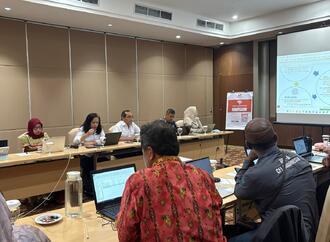
.jpeg) Participants in the RSKKNI P3W Laut Convention take part in discussions and the refinement of the Draft Indonesian National Work Competency Standard for Fisheries Management with an Ecosystem Approach in Marine Waters (RSKKNI P3W Laut) at the Pullman Jakarta Hotel, 16–17 September 2026. The forum was an important step towards developing human resource competency standards to support ecosystem-based fisheries management.
Participants in the RSKKNI P3W Laut Convention take part in discussions and the refinement of the Draft Indonesian National Work Competency Standard for Fisheries Management with an Ecosystem Approach in Marine Waters (RSKKNI P3W Laut) at the Pullman Jakarta Hotel, 16–17 September 2026. The forum was an important step towards developing human resource competency standards to support ecosystem-based fisheries management.
The convention, organised by the Centre for Standardisation and Certification of Marine and Fisheries Human Resources of the Ministry of Marine Affairs and Fisheries (MMAF), with support from the GEF-6 CFI Indonesia Programme, brought together representatives of government, academia, research institutions, practitioners, professional associations, education and training institutions, certification bodies, business and industry, as well as the drafting and verification teams.
The forum provided a platform to test and build consensus on the draft competency standards, which are expected to serve as a reference for human resource development in ecosystem-based fisheries management..
Director of Competency Standardization and Training Programme at the Ministry of Manpower, Abdullah Qiqi Asmara, said fisheries management could no longer rely on conventional approaches. The use of marine resources needs to be balanced with the sustainability of ecosystems.
“These policy transformations and strategic approaches require human resources with validated technical and managerial capabilities, as well as an understanding of ecological considerations. Therefore, the development of SKKNI is an important foundation,” he said.
According to Qiqi, SKKNI also serves as a link and match instrument connecting education and training with the needs of the world of work. Competency standards can help ensure that the capabilities developed through education and training correspond to actual needs in the field.
Policies Require Competent Human Resources
Head of the Center for Standardization and Certification of Marine Affairs and Fisheries Human Resources, Anastasia Rita Tisiana Dwi Kuswardani, emphasized that fisheries management today is not simply about determining how much fish can be harvested.
.jpeg) Head of the Center for Standardization and Certification of Marine Affairs and Fisheries Human Resources, Anastasia Rita Tisiana Dwi Kuswardani, accompanied by Convention Chair Dr. Ir. M. Fedi Alfiadi Sondita, M.Sc., opens the Convention on the Draft Indonesian National Work Competency Standard for Fisheries Management with an Ecosystem Approach in Marine Waters (RSKKNI P3W Laut) at the Pullman Jakarta Hotel on 16 September 2026.
Head of the Center for Standardization and Certification of Marine Affairs and Fisheries Human Resources, Anastasia Rita Tisiana Dwi Kuswardani, accompanied by Convention Chair Dr. Ir. M. Fedi Alfiadi Sondita, M.Sc., opens the Convention on the Draft Indonesian National Work Competency Standard for Fisheries Management with an Ecosystem Approach in Marine Waters (RSKKNI P3W Laut) at the Pullman Jakarta Hotel on 16 September 2026.
An ecosystem approach requires an understanding of the interconnections among fishery resources, ecosystem conditions, resource-use activities, socioeconomic conditions, and the interests of different stakeholders.
“Good policies will only be effective when implemented by people with the right competencies,” Anastasia stressed.
Therefore, the required competencies extend beyond conceptual understanding. The personnel also need to be able to use data and information to assess fisheries conditions, identify risks, formulate management measures, engage stakeholders, monitor policy impacts, and make adjustments when conditions change.
From Data to Evaluation
Convention Chair Dr. Ir. M. Fedi Alfiadi Sondita, M.Sc., explained that the 25 competency units discussed during the convention were developed based on a work map covering the full cycle of fisheries management with an ecosystem approach.
According to Fedi, four key functions form the foundation for developing the competencies: preparing fisheries management plan documents; implementing the utilisation of fishery resources using an ecosystem approach; conserving marine ecosystems; and evaluating fisheries management using an ecosystem approach.
These four functions represent a management cycle that begins with planning, proceeds to implementation, and is followed by evaluation.
“Everything starts with data. The data are then analysed to identify the problems that need to be addressed. Only then can management objectives and strategies be developed,” he explained.
At the implementation stage, the competencies focus on carrying out action plans and applying principles that support effective management. The conservation component, meanwhile, includes improving fish habitat and restoring fishery resources.
The next stage is evaluation, through assessing the status of fisheries management using ecosystem-approach indicators and using the assessment results to improve management.
These functions were then translated into basic functions that form the titles of the 25 RSKKNI P3W Laut competency units.
Ensuring the Standards Can Be Applied
Convention Organizing Committee Chair Wahyu Jati Purnamingsih said that the development of the 25 competency units was the result of a process that had been underway since early 2026. The process included establishing the drafting and verification teams, brainstorming and developing the competency map, defining competency elements and performance criteria, conducting internal and external verification, and holding a pre-convention in August 2026.
The draft was subsequently brought to the convention forum to receive input, corrections, and agreement from stakeholders.
Fedi emphasised that the group sessions were not merely about reviewing the wording of the document. Participants needed to ensure that each competency unit was relevant to fisheries management needs in Indonesia, that its performance criteria could be measured and tested, and that it could serve as a reference for education and training programmes.
Another important question was whether individuals declared competent under the standards would ultimately be able to make a reliable contribution to fisheries management using an ecosystem approach.
.jpeg) The results of the RSKKNI P3W Laut Convention are formally handed over through the submission of the discussion outcomes and minutes to the relevant Head of Centre as part of the process of finalising the Draft Indonesian National Work Competency Standards for Fisheries Management with an Ecosystem Approach in Marine Waters. The activity took place at the Pullman Hotel Jakarta on 16–17 September 2026.
The results of the RSKKNI P3W Laut Convention are formally handed over through the submission of the discussion outcomes and minutes to the relevant Head of Centre as part of the process of finalising the Draft Indonesian National Work Competency Standards for Fisheries Management with an Ecosystem Approach in Marine Waters. The activity took place at the Pullman Hotel Jakarta on 16–17 September 2026.
Towards the close of the activity, the entire series of discussions was documented in the session outcomes and official minutes of the convention. As part of the final stage of the convention, Chair of the RSKKNI P3W Laut Convention, Dr. Ir. M. Fedi Alfiadi Sondita, M.Sc., handed them over to Anastasia Rita Tisiana Dwi Kuswardani, Head of the Centre for Standardisation and Certification of Marine and Fisheries Human Resources.
The handover marked the conclusion of the convention discussions and represented an important step in the follow-up process for developing the RSKKNI P3W Laut.
Thus, the convention was not merely intended to finalise a document, but also to ensure that the resulting standards are credible, measurable, applicable, and aligned with the needs of the marine and fisheries sector.
The RSKKNI P3W Laut is expected to serve as a bridge between policy, the world of work, education and training, competency certification, and resource-management practices on the ground.
Sustainable fisheries depend not only on how well management plans are developed, but also on the ability of people to translate data into decisions, decisions into action, and the results of action into learning. Through the systematic development of 25 competency units, RSKKNI P3W Laut is intended to strengthen human resources capable of bringing the ecosystem approach from the policy arena into the practical management of Indonesia’s fisheries.
0 COMMENTS