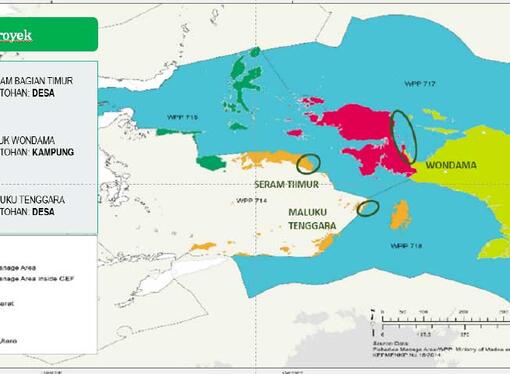

The initiative forms part of a national study conducted simultaneously in four locations—Merauke, Dobo, Ambon, and Sorong.
The forum brought together representatives from the central and subnational governments, fisheries monitoring and enforcement authorities, academics, business actors, customary leaders, fishers' organizations, and coastal communities to gather diverse perspectives on the implementation of Shrimp Trawl Net (Jaring Hela Udang Berkantong/JHUB) as input for the formulation of national policy recommendations.
.jpeg) The Focus Group Discussion (FGD) on the Ecological and Socio-Economic Impact Assessment of JHUB Operations in Fisheries Management Area of the Republic of Indonesia (WPPNRI or FMA) 718 was conducted in a hybrid format. The discussion forms part of the process of developing evidence-based policy recommendations for shrimp fisheries management through the participation of government agencies, academia, fishers, business actors, and a broad range of stakeholders.
The Focus Group Discussion (FGD) on the Ecological and Socio-Economic Impact Assessment of JHUB Operations in Fisheries Management Area of the Republic of Indonesia (WPPNRI or FMA) 718 was conducted in a hybrid format. The discussion forms part of the process of developing evidence-based policy recommendations for shrimp fisheries management through the participation of government agencies, academia, fishers, business actors, and a broad range of stakeholders.
Director of Fisheries Resources Management at the Ministry of Marine Affairs and Fisheries (MMAF), Syahril Abd Raup, emphasized that the study is not intended to determine who is right or wrong, but rather to ensure that every fisheries management policy is developed on a sound scientific basis.
"The Arafura Sea is one of Indonesia's strategic fishing grounds for shrimp and squid production. Therefore, every policy must maintain a balance between the sustainability of fishery resources, ecosystem protection, and the well-being of coastal communities," he said.
According to Syahril, the multidisciplinary findings generated from the various study locations will serve as the basis for formulating policy recommendations on JHUB management in WPPNRI 718 while supporting the implementation of Indonesia's Quota-Based Fisheries (PIT) Policy, which upholds the principles of sustainability.
 ok.jpeg .jpeg) Vice Governor of South Papua, Paskalis Imadawa, S.Pd., delivered his opening remarks and officially inaugurated the FGD on the Ecological and Socio-Economic Impact Assessment of JHUB Operations in WPPNRI 718 as part of efforts to strengthen science-based and sustainable shrimp fisheries management.
Vice Governor of South Papua, Paskalis Imadawa, S.Pd., delivered his opening remarks and officially inaugurated the FGD on the Ecological and Socio-Economic Impact Assessment of JHUB Operations in WPPNRI 718 as part of efforts to strengthen science-based and sustainable shrimp fisheries management.
The management of JHUB operations in the Arafura Sea has also become a key concern of the South Papua Provincial Government. Vice Governor Paskalis Imadawa stressed that investment in the fisheries sector must generate tangible benefits for local communities.
"Investors must maintain harmonious relationships with local fishers. The presence of the fishing industry should not displace the livelihoods of local communities; instead, it should become a partner in strengthening the economic resilience of fishers," he emphasized.
During the forum, MMAF fisheries inspectors presented several field findings that require further attention. The Coordinator of the Merauke Surveillance for Marine and Fisheries Resources (PSDKP) Surveillance Unit reported that inspections continue to identify technical violations, ranging from the use of non-compliant mesh sizes to non-compliance with fishing gear specifications.
Operational data also indicate that catches from JHUB vessels continue to be dominated by fish rather than shrimp, which is the primary target species. This finding warrants further assessment to evaluate the effectiveness of the fishing gear and better understand its implications for the sustainability of fishery resources.
In addition to technical aspects, the forum also highlighted the increasing competition for fishing grounds between JHUB vessels and traditional fishers. Representatives of the Indonesian Fishermen Association (HNSI), together with local fishers, expressed concerns over the sustainability of their livelihoods should marine spatial management fail to ensure equitable access.
“We hope that every policy will genuinely protect local fishers. Change is necessary, but it should not come at the expense of coastal communities,” said one fisher representative.
Nevertheless, several customary leaders and business representatives emphasized that investment remains welcome, provided it economically benefits local communities, purchases fishers' catches, creates employment opportunities, and is implemented transparently through adequate stakeholder engagement.
From a fisheries business perspective, the Head of Merauke Fishing Port stressed that sustainable fisheries management depends not only on regulating fishing gear but also on maintaining an efficient supply chain. Strengthening supporting infrastructure—including cold storage facilities, ice plants, and market access—is considered essential to ensure that the added value of fisheries products is retained within local communities.
Meanwhile, business representatives reaffirmed their commitment to developing local market chains, purchasing catches from local fishers, and expanding investment in Merauke as part of broader regional economic development efforts.
Throughout the discussion, participants also underscored the need to strengthen vessel monitoring and enforcement, review operational fishing boundaries, improve compliance with fisheries regulations, safeguard the rights of Indigenous Peoples, and enhance scientific data on shrimp stocks and the ecosystem dynamics of the Arafura Sea.
Overall, the forum produced several key recommendations, including the need for periodic assessments of benthic habitat conditions, strengthened oversight of JHUB operations, a review of the shrimp fishing season, continued development of fisheries infrastructure, enhanced protection for local fishers, and stronger inter-agency coordination in the management of WPPNRI 718.
All inputs gathered through the FGD in Merauke, together with the findings of parallel assessments conducted in Dobo, Ambon, and Sorong, will be consolidated into a set of national recommendations to support the formulation of a more adaptive, evidence-based, and equitable policy framework for JHUB management.
Through this collaborative approach, MMAF expects fisheries management in the Arafura Sea to support the implementation of the Quota-Based Fisheries Policy, ensure the sustainability of fish stocks, protect coastal ecosystems, and deliver greater economic benefits to Indonesia's fishing communities.
0 COMMENTS